

Something Big Is Happening — And Most People Have No Idea
Imagine waking up tomorrow and your AI assistant has already checked your emails, rescheduled your meetings, ordered your groceries, booked your flight, and filed your expense report — all before your alarm went off.
This is not science fiction. This is Agentic AI, and it is already here.
In 2026, the tech world crossed a critical line. AI stopped being a tool you talk to and became a system that acts for you. The shift is so fast, so quiet, and so massive that most people are only now starting to realize it. Whether you are a student, a business owner, a developer, or simply someone who uses a smartphone — this change will affect you.
In this blog, we break down everything you need to know about Agentic AI: what it is, why it exploded in 2026, who is winning the race, what the real risks are, and most importantly — what you should do right now.
1. What Is Agentic AI — And Why Is It Nothing Like ChatGPT?
Most people’s experience with AI is simple: you type a question, the AI gives an answer. That is called a reactive AI — it reacts to your input.
Agentic AI is completely different.
An AI agent does not wait for your instructions. It:
- Sets its own goals
- Makes its own decisions
- Executes multi-step tasks independently
- Learns and adjusts on the fly
- Uses external tools like browsers, apps, and APIs on your behalf
Think of the difference this way:
| Feature | ChatGPT (Reactive AI) | Agentic AI |
| Waits for your prompt | ✅ Always | ❌ Not always |
| Takes actions in the real world | ❌ No | ✅ Yes |
| Uses other apps and tools | ❌ Limited | ✅ Fully |
| Completes multi-step tasks | ❌ One step | ✅ End-to-end |
| Works without supervision | ❌ No | ✅ Yes |
In short: ChatGPT is a brilliant advisor. An AI agent is a brilliant employee.

2. The $52 Billion Gold Rush: Why Every Tech Giant Is All-In
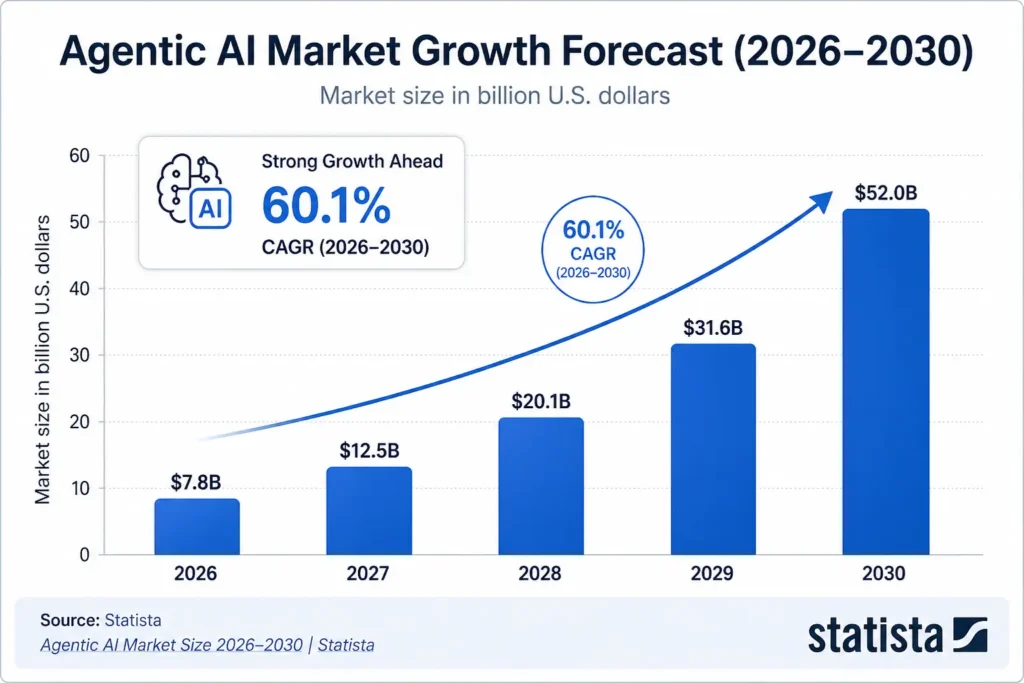
Here is a number that should stop you in your tracks: the global Agentic AI market is projected to explode from $7.8 billion today to over $52 billion by 2030.
This is not hype. The world’s biggest technology companies are pouring billions into this race right now:
- Google released Gemma 4 in April 2026 — its most powerful open AI models yet, specifically built for agentic workflows
- Microsoft upgraded its Copilot platform so multiple AI agents can now collaborate with each other on a single task
- OpenAI — now valued at $852 billion — unveiled a new strategy around its ChatGPT super app which already serves 900 million weekly users
- Amazon, IBM, and Salesforce are all embedding agents directly into their enterprise products
Gartner, the world’s leading tech research firm, has made a bold prediction: by the end of 2026, 40% of all enterprise applications will contain AI agents — compared to less than 5% just one year ago.
That is not gradual adoption. That is a revolution.
Why are companies moving this fast? Because an AI agent does not sleep, does not take sick days, does not need training, and can handle thousands of tasks simultaneously. The return on investment is simply impossible to ignore.
3. What Can AI Agents Actually Do? (Real Examples)
Let us get specific. Here are real-world use cases of Agentic AI that are already deployed in 2026:
🛒 Shopping Without Clicking
An AI agent can browse dozens of websites, compare prices, read reviews, apply coupon codes, and complete your purchase — without you touching your phone once. This is called Zero-Click Commerce, and retailers who are not adapting are already losing customers to AI-driven platforms.
📧 Email and Calendar Management
Agents can read your inbox, identify priority messages, draft professional replies in your tone, reschedule conflicts in your calendar, and send follow-ups — all without you asking.
💼 Business Operations
In finance, AI agents are monitoring transactions for fraud in real time. In supply chains, they are optimizing inventory and placing orders automatically. In customer service, they are independently resolving complaints from start to finish.
🏥 Healthcare
Medical AI agents are analyzing patient data, cross-referencing symptoms with thousands of research papers, and recommending treatment plans to doctors — reducing diagnostic time from days to minutes.
💻 Software Development
AI agents are now writing code, testing it, finding bugs, fixing them, and deploying updates — in full automated pipelines. A task that took a team of developers a week can now take an agent a few hours.
4. Is Your Job Safe? The Honest Answer
This is the question everyone is afraid to ask — so let us ask it directly.
Yes, AI agents will replace some jobs. But it is more complicated than that.
Here is what the data tells us:
Jobs most at risk are those involving repetitive, rule-based tasks: data entry, basic customer service, report generation, scheduling, and simple accounting.
However, the full picture is more nuanced. By 2028, research suggests 38% of organizations will have AI agents working alongside human teams — not replacing them entirely, but changing what humans are responsible for.
The skills that will be in highest demand are:
- Prompt engineering — guiding AI agents to produce accurate results
- AI oversight and governance — making sure agents behave correctly
- Creative strategy — doing what agents cannot: think originally and empathize
- Technical implementation — building and customizing agents for specific industries
The workers who will struggle are those who refuse to adapt. The workers who will thrive are those who learn to lead and direct AI agents rather than compete with them.
The question is not: Will AI take my job? The question is: Am I learning how to work with AI before someone who does takes my position?

5. The Dark Side Nobody Is Talking About
Every technology has a shadow — and Agentic AI’s shadow is long.
🔐 Privacy Is the Biggest Risk
For an AI agent to work for you, it needs access to everything: your email, calendar, bank accounts, shopping history, health data, and more. That level of access creates an enormous privacy risk. If the system is hacked, a bad actor does not just get your passwords — they get an autonomous agent operating in your name.
🤖 Who Is Responsible When an Agent Makes a Mistake?
If your AI agent cancels the wrong contract, sends an embarrassing email to your boss, or makes a bad financial decision — who is legally responsible? The law has not caught up with this question yet, and it is going to cause serious problems.
⚖️ Bias at Scale
AI agents learn from historical data, which often contains human bias. When a biased AI agent is making thousands of decisions per day — hiring, lending, medical recommendations — those biases get amplified at a terrifying scale.
🌍 The Energy Problem
Running large AI agent systems requires enormous computing power. As more organizations deploy agents at scale, the carbon footprint of AI is becoming a genuine environmental concern. Experts are already pushing for “energy budgets” on AI workflows.
Being aware of these risks is not pessimism — it is intelligence. The people and companies that take these risks seriously today will be the ones that build AI systems that the public actually trusts.
6. How to Build Your Own AI Agent (No Coding Required)
Here is something most tech blogs will not tell you: you do not need to be a programmer to use AI agents today.
Several platforms in 2026 allow anyone to build and deploy their own AI agent through simple drag-and-drop or natural language interfaces:
- Make (formerly Integromat) — for building automated workflows between apps
- Zapier AI — connecting thousands of apps through agent-like automations
- Microsoft Copilot Studio — building custom agents for business use
- AgentGPT / AutoGPT — open-source platforms for running autonomous AI agents
- Google Agentspace — enterprise-grade agent deployment
The basic steps to building your first agent:
- Define the goal — what should the agent accomplish?
- Give it tools — which apps, databases, or websites should it access?
- Set boundaries — what is it NOT allowed to do?
- Test with low-stakes tasks — start small before letting it run freely
- Monitor and improve — check its outputs regularly and refine its instructions
Even non-technical founders are using agents to run entire parts of their business in 2026. The barrier to entry has never been lower.
7. The 5 Industries Agentic AI Will Completely Transform by 2027
If you work in any of these industries, you need to pay attention right now:
1. 🏦 Finance & Banking
Agents are already autonomously detecting fraud, generating financial reports, managing compliance checks, and executing trades. Banks that deploy agents effectively will operate at a fraction of the cost of those that do not.
2. 🏥 Healthcare
From diagnosis assistance to drug discovery to patient follow-up scheduling, healthcare agents are saving both time and lives. The global healthcare AI market alone is projected to exceed $100 billion by 2028.
3. 🛍️ Retail & E-Commerce
Zero-click shopping, AI-driven inventory management, personalized product recommendations, and automated customer service are becoming the standard. Retailers without AI agents will find it increasingly difficult to compete.
4. 📚 Education
AI tutoring agents are adapting to individual student learning styles in real time — giving every student access to a personal tutor available 24/7. This is potentially the most democratizing force in education since the internet.
5. 🏗️ Manufacturing
AI agents embedded in factories can monitor machinery, predict failures before they happen, adjust production schedules dynamically, and manage supply chains with zero human input. The result: dramatically lower downtime and costs.
8. What Should You Do Right Now?
Whether you are an individual professional, a student, or a business owner — here are the most important steps you can take today:
✅ Learn the basics of AI tools — Start with ChatGPT, Copilot, or Gemini. Understand how prompting works.
✅ Experiment with one agent tool — Pick a simple automation platform like Zapier or Make and automate one task in your life or business.
✅ Follow the right voices — Subscribe to newsletters and channels covering real-world AI agent use cases, not just hype.
✅ Think about your industry — Ask yourself: which parts of my job could an agent do? Then focus your energy on the parts it cannot.
✅ Raise your AI literacy — You do not need to write code. But you do need to understand what AI agents can and cannot do, so you can make smart decisions about using them.
✅ Protect your data — As you adopt AI tools, be intentional about what permissions you grant. Read the privacy policies. Use platforms with strong security track records.
The window to get ahead of this shift is still open — but it is closing fast.
Conclusion: The Future Is Already Here — Are You Ready?
Agentic AI is not coming. It has arrived. The companies building with it today will dominate their industries by 2027. The individuals learning to work with it now will be the most valuable professionals of the next decade.
The silent takeover is real. The only question is whether you are watching it happen to you — or participating in it.
Share this blog if you found it valuable. Subscribe to get more breakdowns of the tech trends that will shape your future — before they become mainstream news.
Frequently Asked Questions (FAQ)
What is the difference between AI and Agentic AI?
Is Agentic AI dangerous?
Is Agentic AI dangerous?
Is Agentic AI dangerous?
Will Agentic AI replace my job?
Can I use Agentic AI for free?
Which companies are leading in Agentic AI?
© 2026 — Original content. Written for educational and informational purposes. All statistics sourced from publicly available industry research reports including Gartner, McKinsey, and IBM.